![Music-weinberg.net front page snapshot]()
Marking the 20th anniversary of the oldest internet resource devoted solely to Mieczysław Weinberg's life and music (continuously serving readers since 2002),
music-weinberg.net has finally been completed with the addition of the anticipated pages on
CD Recording Recommendations and Reviews and
Further Reading. The site was first begun in 2002 out of an inner necessity to make the music of what was then a strangely neglected genius more widely known. It was subsequently revised in 2012 and then substantially expanded and re-designed in 2020, with the aim of presenting a more unified aesthetic experience, if possible, in accord with the music itself. This final update in 2022/23 comes at a time when Weinberg's (re-)discovery is well underway, with new recordings appearing on a monthly basis. It is hoped that readers – be they casual listeners or musicians – will leave music-weinberg.net with a deeper understanding and appreciation of one of the 20th century's “greats”, while being in some small way ideally and aesthetically enriched.
Mirga Gražinytė-Tyla's much-awaited sequel to her previous DG recording has been released, containing Weinberg's Symphonies Nos. 3 and 7 (Opp. 45, 81) from 1949 and 1964, respectively, along with the first flute concerto (Op. 75).
Naxos and Capriccio have released a live recording of The Passenger
Op. 97 on DVD, Blu-ray disc and CD, with Roland Kluttig conducting the Choir of the Graz Opera, the Grazer Philharmoniker, and several outstanding soloists.
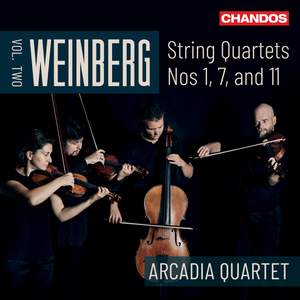
Volume 2 of the Arcadia Quartet's projected complete cycle of Weinberg's 17 string quartets has been released on Chandos. This release contains quartets 1, 7 and 11 (Opp. 2/141, 59, 89). The ensemble will also be performing Weinberg's quartets 6, 15 and 16 in
several locations across the UK during March 2023.
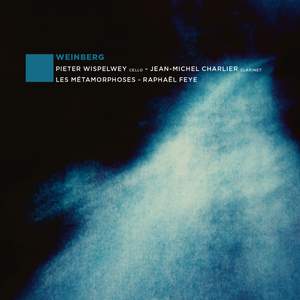
The Dutch cellist Pieter Wispelwey performs Weinberg's Op. 43 Cello Concerto on this new release with Les Métamorphoses, conducted by Raphaël Feye. The release also includes the Op. 52 Fantasia and Weinberg's final Chamber Symphony, Op. 153, with clarinet obbligato.
Toccata Classics has released the third and penultimate volume of UK-based violinist Yuri Kalnits and pianist Michael Csányi-Wills' survey of Weinberg's chamber works for violin. Kalnits' accounts of the Op. 82 and 95 violin solo sonatas have been particularly distinguished on previous volumes, and this release completes the set with a performance of the Op. 126 sonata that is different yet no less substantial than Gidon Kremer's seminal version on ECM.
Weinberg's great opera The Passenger Op. 97 will be performed during
June 2020 at the Teatro Real in Madrid, Spain, in a production by David Pountney (see the
Teatro Real's website for more information). This follows just a few months after a
Canadian premiere of the work by the UBC Opera in Vancouver in
February 2020, as part of a Holocaust commemorative symposium (
thanks to Skye Donald for sharing this information).
Weinberg's last opera The Idiot Op. 144 will be performed on the 18th of March 2020 at the Mariinsky Ballet and Opera Theatre in St. Petersburg, Russia, in a performance conducted by Zaurbek Gugkaev, with Thomas Sanderling as musical director and Ilya Ustyantsev as stage director. This staging will follow Thomas Sanderling's highly acclaimed production of the work during 2013 in Germany (National-theatre Mannheim).
Following on from their series of centenary concerts, Quatuor Danel continues its traversal of Weinberg and Shostakovich's string quartet cycles in 2020, with concerts on
25 March, 16 May and 9 July 2020 at
Wigmore Hall in London. The Wigmore Hall website (link above) also has an excellent – really, a must-hear – podcast with UK-based musicologist Dan Elphick and lead violinist of the Quatuor Danel, Marc Danel, who discuss Weinberg's life and music, with a focus on his string quartets. Still in the UK, the Trio Khnopff will be performing Weinberg's Piano trio Op. 24 on the
5th of April 2020 at Conway Hall, Holborn (tickets and additional information can be seen
here).
In line with his recent UK premiere of Weinberg's Cello concerto Op. 43, the UK-based cellist Raphael Wallfisch has recorded the same work for CPO with the Kristiansand Symphony Orchestra (conducted by Łukasz Borowicz), along with Weinberg's earlier Cello concertino Op. 43bis (on which the larger cello concerto is based) and the Fantasia for cello and orchestra Op. 52.
A new recording on Sony Classics of Weinberg's monumental Piano Quintet Op. 18 has been released, with the Kuss Quartet accompanied by Olga Scheps on piano.
DG continues its acclaimed exploration of Weinberg's music with Gidon Kremer and members of the Kremerata Baltica in some of Weinberg's chamber music: the Piano trio Op. 24 and the Sonata for violin and piano No. 6 Op. 136bis, among several early works.
The Baruch Performing Arts Center in New York will be hosting two concerts which include chamber works by Weinberg. The first concert (“Music from Exile”) will be on
November 12th 2019, with the Daedalus Quartet and Renana Gutman performing Weinberg's Piano Quintet Op. 18 alongside works from Ullman and Bolaños. The second concert (“Fate and Genius”) will be on
March 17th 2020, with the Clarion Quartet performing Weinberg's String Quartet No. 2 alongside Shostakovich's 7th and Beethoven's 16th string quartets. Further information and tickets are available
here (first concert) and
here (second concert). (
Thanks to Caleb Jaster and Erica Murase-Fernandez for providing the details about these upcoming concerts).
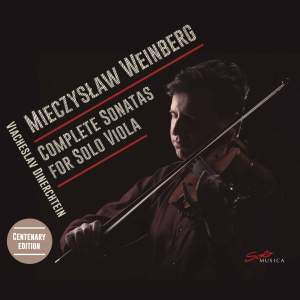
A new recording on the German label Solo Musica has recently being released of Weinberg's four Viola Solo Sonatas (Opp. 107, 123, 135, 136), performed by Viacheslav Dinerchtein. These are highly sophisticated, intellectually challenging and deeply spiritual works, and they are outstandingly interpreted by V. Dinerchtein, with much emotion and devotedness.
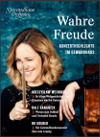
There is an article in the German
Gewandhaus Orchestra magazine, available on Issuu, about the life and music of Weinberg. The article is related to a
series of upcoming concerts in Leipzig, Germany, which are the Gewandhaus Orchestra's tribute to Weinberg's birth-date centenary (b. 1919 – 2019). The concerts themselves will be spread throughout 2019 and 2020, beginning with several concerts that include Weinberg's chamber music (the first of these on
16th October 2019) and ending in a concert that includes Weinberg's film music (on
15th February 2020). Some of the musicians who will perform include Gidon Kremer, Martha Argerich, Sol Gabetta, the members of Quatuor Danel, and others – among, of course, members of the Gewandhaus Orchestra. Tickets are available
here. There is also an
interview with Sol Gabetta, including contributions from Linus Roth and Gidon Kremer, on the German KlickKlack program (also
viewable on YouTube). (
Many thanks to Maria Elena Aguirre for providing the details about the magazine article, KlickKlack interview, and concerts).
Raphael Wallfisch will be performing Weinberg’s Cello Concertino Op. 43bis in two UK premiere concerts (alongside works by Tchaikovsky, Schubert and Holst): at the Stoller Hall, Manchester, on Friday 8th of November 2019, and at Macclesfield Heritage Centre on Saturday 9th of November 2019. See
here for more information and to book tickets. (
Thanks to Siobhan Parker for providing the details about this performance).
Yulia Chaplina, Igor Yuzefovich and Yuri Kalnits will be performing several works by Weinberg (Sonata for two violins, Op. 69; a selection of piano pieces from the Children's Notebook Op. 16; and the Sonatina for violin and piano, Op. 46) alongside works by Shostakovich, Prokofiev, Shchedrin and Khachaturian, at the Pushkin House in London, 3rd December 2019. More information and tickets are available from the
Pushkin House site.
Sol Gabetta will be performing Weinberg’s Cello Concerto Op. 43 at the BBC Proms, on 6th August 2019. For more information and tickets, visit the
BBC Proms site. See also the announcement on
Polish Radio. (
Thanks to Maria Elena Aguirre for providing the details about this performance, just in time!).
DG has recently released a recording of Weinberg's Symphony No. 2 Op. 30 for strings and Symphony No. 21 Op. 152 – the last of Weinberg's fully completed and orchestrated symphonies – with the City of Birmingham Symphony Orchestra and Kremerata Baltica (together with Gidon Kremer), conducted by Mirga Gražinytė-Tyla. The recording has already garnered very positive reviews.
Josef Fiegleson, who has previously recorded all of Weinberg's works for solo cello to much acclaim, will be performing Weinberg's Solo Cello Preludes Op. 100 at the Stephen Wise Free Synagogue in New York City, on 19th of May, 2019 – see
Improvis Productions for more information. Tickets are available via
EventBrite. (
Thanks to Art Feldman for providing the details about this performance).
Quatuor Danel will be performing Weinberg's complete string quartets over a series of five concerts in Washington DC, US, with the first concert held on
April 28th, 2019 (String quartets Nos. 1 – 3), then on May 5th, 2019 (Nos. 4 – 6 at the
1pm concert, and Nos. 7 – 10 at the
4pm concert) and finally on May 12th, 2019 (Nos. 11 – 13 at the
1pm concert, and Nos. 14 – 17 at the
4pm concert). (
Thanks to Alan P. Vollmann for providing the details about this performance).
Mark Glanville (bass-baritone) and Marc Verter (piano) will be performing a Weinberg song programme, “Citizen of Nowhere - Weinberg, A Sung Life” in the Purcell Room, Southbank Center, London, UK on the 3rd of February, 2019 (see
here for more information and tickets). The full progamme will be recorded in March for commercial release. The two musicians are aiming to perform the programme more widely, so it is worth keeping an eye on future concerts/recitals (most likely in the UK in the first instance). A song from a previous recital at Manchester University in November 2018 can be
heard here on YouTube.
The cellist Sol Gabetta will be performing Weinberg's Cello Concerto Op. 43 (among works by Dukas, Strauss and Ravel) during December 2018, with the Orchestre Philharmonique de Radio France under Mikko Franck, in Cologne (13th December), Dusseldorf (14th December), Hamburg (15th December), Vienna (16th December), Munich (19th December), Hannover (20th December) and Paris (21st December). For more information and ticket bookings, see
Sol Gabetta's site or visit the site of Radio France's
Maison de la Radio (includes information on the Vienna and Paris concerts).
Update: A live recording of the Paris concert is
available on YouTube, courtesy of France Musique and Arte France. (
Thanks to Maria Elena Aguirre for providing the details about this performance and the YouTube link).
The most recent release in Naxos' ongoing series of Weinberg's symphonies features the poignant Symphony No. 13 together with the lighter Serenade Op. 47,4, conducted by Vladimir Lande. Both are world premiere recordings.
On Saturday 31st March, 7.30pm, there will be a concert at the IMS Prussia Cove/Marazion Community Centre, Marazion, Cornwall, UK, where Gidon Kremer will perform his own violin solo arrangement of 12 of Weinberg's 24 Preludes for Solo Cello Op. 100. Details and booking information can be accessed at the
International Musicians Seminar site. (
Thanks to Rosie Yeatman for providing the details about this performance).
Weinberg's opera “The Passenger” Op. 97 will be performed in Aarhus, Denmark, at the
Jyske Opera during August 2018, by the Chorus of the Danish National Opera, soloists and Aarhus Symfoniorkester under Christopher Lichtenstein. (
Thanks to Lene Juul Langballe for providing the details about this performance).
The Silesian Quartet has recently embarked on recording the complete cycle of Weinberg string quartets. This is a significant undertaking which the Poland-based ensemble is aiming to complete by the end of 2019.
CPO has released a 2 CD companion to their earlier, 2009 volume of Weinberg's Violin Sonatas 4 and 5. The new recording, like its predecessor, is performed by the Kirpal brothers Stefan and Andreas with exceptional sensitivity, understanding, nuance and depth, and includes the remaining four Violin Sonatas from the complete cycle of six: Nos. 1, 2, 3 and 6, as well as a world premiere recording of Weinberg's Sonata for Two Violins Op. 69.
Weinberg's Violin Concerto from 1959 was performed by Gidon Kremer and the Boston Symphony Orchestra, conducted by Juanjo Mena, on January 19-21 & 24, 2017, to much acclaim. The concert also included symphonic works by Tchaikovsky and Prokofiev. (Thanks to Neal Carey for providing the details about this performance).
The most recent volume in Naxos' ongoing series of Weinberg's symphonies has been released, featuring Symphony No. 17, which is the first in Weinberg's “war trilogy” from the 1980s. The following two symphonies of the trilogy (namely, Nos. 18 and 19) are also available on Naxos and also conducted by Vladimir Lande on earlier releases. Besides the large-scale, 45-minute Symphony 17, the new recording includes a world premiere of the Suite for Orchestra from 1950.
There is an upcoming concert on Thursday, 3rd of November 2016 at the Scottsdale Center for the Performing Arts, Arizona,
where the Warsaw Philharmonic under Jacek Kaspszyk will be performing Weinberg's Polish Melodies No. 2, Op. 47.
This concert is part of a USA tour by the Warsaw Philharmonic.
(Thanks to Katrina Becker for providing the details about this performance).
A recently released
recording by
the Philadelphia-based
Dolce Suono Ensemble (Mimi Stillman - flute, and Charles Abramovic - piano)
includes Weinberg's Five Pieces for Flute and Piano from 1947.
Dolce Suono Ensemble gave the first premiere of this work in the USA and this recording represents its world premiere on CD.
Mimi Stillman has also written an article in the Flutist Quarterly on Weinberg's Five Pieces, available
online.
The
Avalon String Quartet will be performing
Weinberg's Quartet No. 6 at Weill Recital Hall at Carnegie Hall on Wednesday, December 9, 2015.
Other programs including Weinberg's Quartet No. 7, as well as the Piano Quintet, are planned for
early 2016 in several venues in Chicago, USA – see
here for details.
(
Thanks to Lee Walter for providing the details about this performance).
A recording of Weinberg's Piano Quintet and two String Quartets (Nos. 10 and 13) has been released on
Praga,
with the Zemlinksy Quartet and Nikita Mndoyants (piano).
The American
Artaria String Quartet will perform
Weinberg's Quartet No. 4 (Op. 20) along with Shostakovich's Quaret No. 3 (Op. 73) on
November 15th, 2015, at Sundin Music Hall, 3pm, in Saint Paul, MN; and again on November 29th, 2015,
at the Wayzata Community Church, 3pm, in Wayzata, MN – as part of their program “Politically Incorrect”.
(
Thanks to Nancy Oliveros for providing the details about these performances).
The
Molinari Quartet, based
in Montréal, Canada, will perform Weinberg's String Quartet No. 14
in several concerts during March 2015, including at the Conservatoire de musique de Montréal on March 28, 2015, and at the Kitchener-Waterloo Chamber Music Society
on March 14, 2015.
(
Thanks to Olga Ranzenhofer for providing the details about these upcoming performances).
Culture.pl, an online magazine promoting
Polish culture abroad, has published an article
Unknown Facts From Mieczysław Wajnberg’s Biography that reveals some
interesting biographical information discovered by Polish musicologist Prof.
Danuta Gwizdalanka. It appears that Weinberg's surname will
remain a subject of controversy for a while (as it has been), but
the newly discovered date of birth is likely to be less disputable.
(
Thanks to Magdalena Dropek for providing the information).
It appears that interest in Weinberg's operas is increasing! From
www.sikorski.de:
“Andrea Schwalbach has now created a new production for the Oldenburg State Theatre [Oldenburgisches Staatstheater]
that will be given its premiere on 24 January 2015 in the Great House of the Theatre. Vito Cristofaro will serve as music director.”
The
Lyric Opera of Chicago
will present David Pountney's production of Weinberg's opera "The Passenger" Op.97 (1967-68) between the 24th of February
and 15th of March, 2015.
"The Passenger",
based on a libretto by Alexander Medvedev, received its world premiere in Bergenz, Austria in 2010 to great acclaim, and
its North American premiere recently at the Houston Grand Opera.
The upcoming staging by the Lyric Opera of Chicago under Sir Andrew Davis confirms the increasing appreciation of a
work that Weinberg thought was his greatest – indeed, a work that thematically underlies so much of his music
dealing with the human suffering endured during WWII.
(
Many thanks to Thomas Holliday for providing the details about this performance).
A recording of Weinberg's Violin concerto and Symphony No. 4 has been released on Warner Classics,
with Jacek Kaspszyk conducting the Warsaw Philharmonic. Ilyia Gringolts is the soloist in the violin concerto.
Frédéric Albou and Michelle Assay recently gave a premiere of some of Weinberg's settings of Shakespeare's Sonnets in an “all-Shakespeare” programme. More information about the
event can be found on the University of Manchester
events page.
A recent recording from Gidon Kremer and the Kremerata Baltica on ECM
of some of Weinberg's chamber music, together with Symphony No. 10, has won a Gramophone Magazine's Editor's Choice award.
And it is well deserved! The disc includes some world premiere recordings, such as
Weinberg's 3rd violin solo sonata, a late work of profound depth and emotion.
Murray McLachlan's seminal recordings of Weinberg's Piano Sonatas 1–6 have been re-released on the Divine Art label
(as
Vol. 9 and
Vol. 10
of an ongoing series dedicated to Russian piano music) and are now widely available. Recorded approximately 20 years ago,
McLachlan's deep insight, sense of balance and modest dedication continue to make these
interpretations of the piano sonatas indispensable.
Weinberg's last operatic masterpiece "The Idiot" Op.144 (1985), after Dostoyevsky's novel of the same name,
was given its world premiere at the National-theatre Mannheim, Germany, on the 9th of May 2013,
conducted by Thomas Sanderling. This is one more successful Weinberg premiere by Thomas Sanderling
in what may turn out to be a whole series, the previous highlight being the Requiem Op. 96
(performed in Liverpool, UK, in 2009).
(Many thanks to Prof. Dr. Jürgen Stolzenberg for providing the initial details about this premiere).
A recording of Weinberg's Symphony No. 8 "Polish Flowers" has been released on
Naxos
(Warsaw Philharmonic Orchestra and Choir, Antoni Wit). It is one of Weinberg's three choral symphonies exploring war-related
themes. Texts are by the Polish poet Julian Tuwim, but translations do not appear to be included.
Weinberg's Piano Quintet and String Quartet No. 8 have been re-released on Melodya (Borodin Quartet, with the composer
himself at the piano). If there is anything resembling a definitive interpretation
of the Quintet, this would have to be it.
A recording of Weinberg's complete sonatas for violin and piano (Nos. 1–6) has been released on
Challenge Records (Linus Roth and José Gallardo).
See also the
YouTube video for this release, containing excerpts and an
interview with the performers. Remarks in the video by violinist Linus Roth about the use of contrast in Weinberg's music have strong
resonance with the
Music section of this site (which was written some time earlier and is thus clearly
spreading a positive influence!). Both performers are truly dedicated to Weinberg's music, and this release is one to look out for.